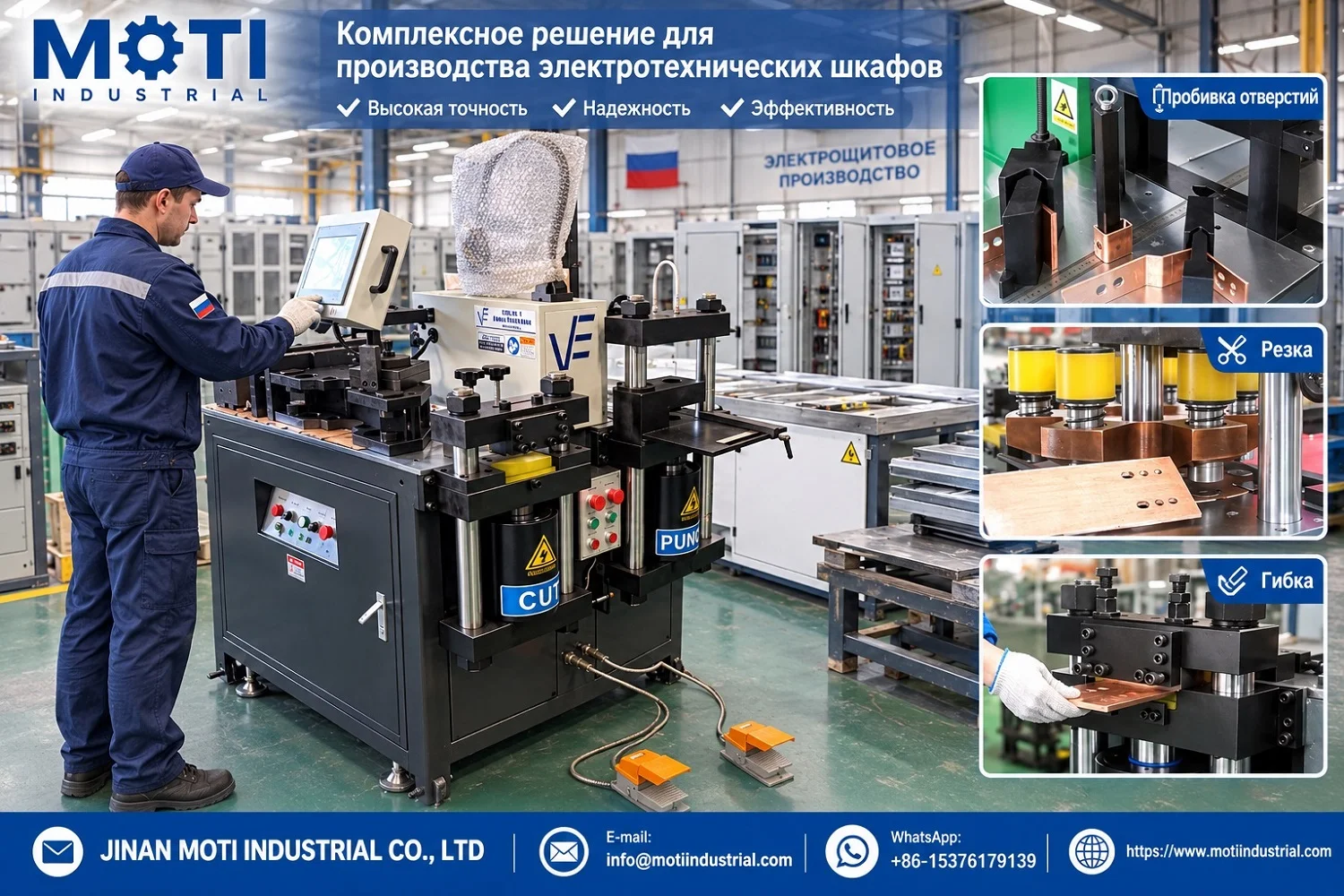
Compact Busbar Machines Shipped to Russia: Cutting, Punching and Bending in a Warm Room
A busbar machine is usually specified by capacity: how thick, how wide, how many tons. For one customer in Russia, the first specification was different.
How small can it be, and can it go indoors?
The two machines now created at the MOTI INDUSTRIAL works are the answer. They are a special build — not a standard catalogue model with a shorter table,
but a redesign around a working condition most machine specs never mention: a Russian winter, and an operator who should not have to spend it in an unheated hall.
1. The Real Specification Was the Room, Not the Machine
In much of Russia, the workshop is not a comfortable place to be for five months of the year. Production halls are large, hard to heat, and expensive to keep warm around the clock.
What happens in practice is predictable: the busbar work gets pushed into a corner, the operator works in gloves, and the machine itself faces conditions it was never designed for
— hydraulic oil that thickens overnight, cold-start stress on the pump, condensation on cold metal when the space is finally warmed.
So the customer asked for something else: a busbar processing setup small enough to be installed in a heated office or a small room, where the people doing the work are warm,
the oil stays at a stable viscosity, and production does not stop because the building is at minus twenty.
That request changed the design brief completely. Instead of asking "how much can this machine process", we had to ask "how little floor space can this machine take, and still do everything".
2. Two Compact Machines Instead of One Long One
The obvious way to build a 3-in-1 busbar machine is one long bed with three stations in a row — punch, shear, bend.
It is efficient, and it is also the reason those machines are two to three metres long and effectively permanent once installed.
This package takes the opposite approach: the three functions are split across two compact, self-contained machines.
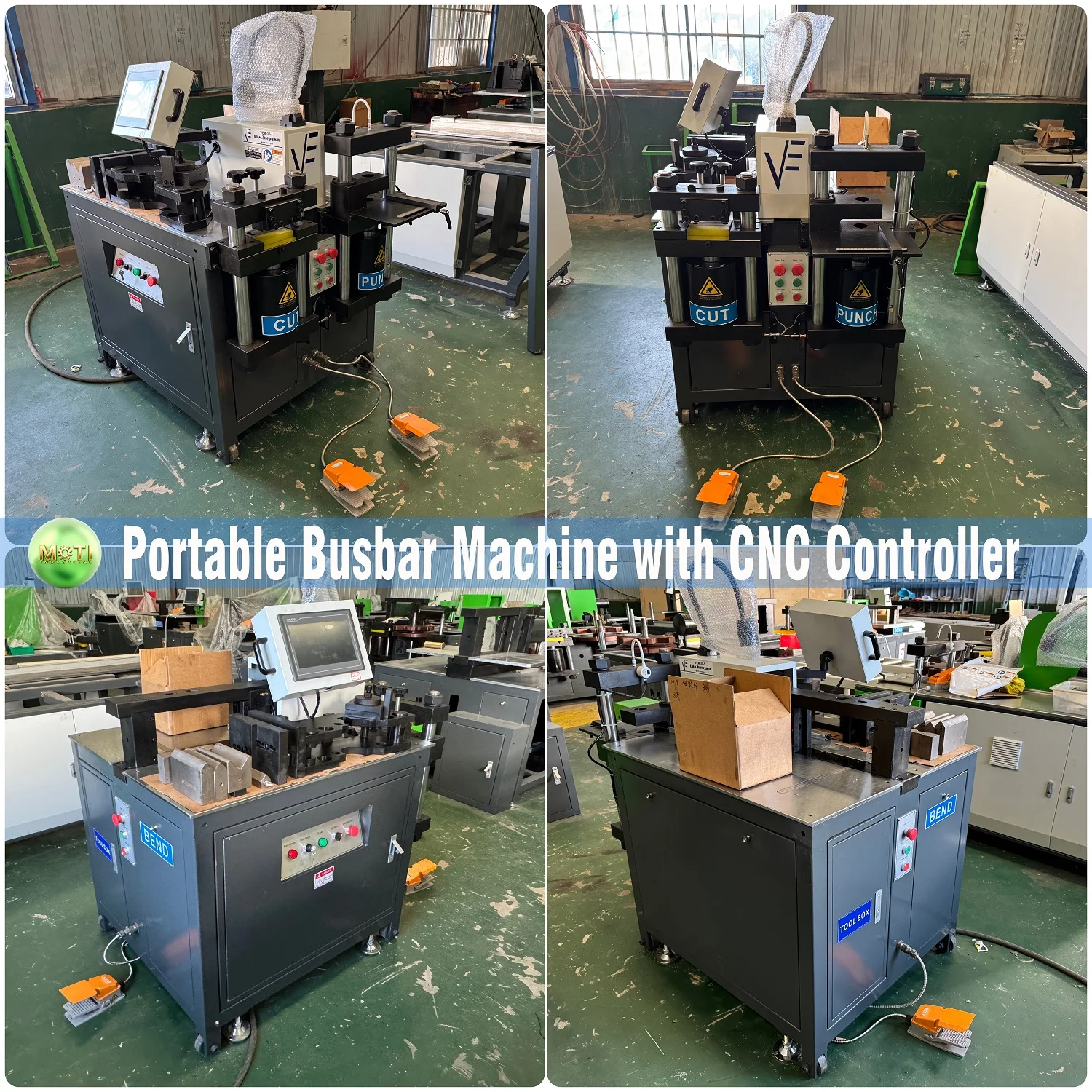
(1) One bending machine — dedicated bending head, its own hydraulic system, MCGS touchscreen HMI on an adjustable arm, and a lockable TOOL BOX compartment built into the base so the die set travels with the machine.
(2) One cutting and punching machine — a twin-station base with a CUT station on the left and a PUNCH station on the right, each on its own cylinder with twin chromed guide columns.
Split this way, neither unit needs the long bed, and each is small enough to be moved through a normal doorway and set down in a room of a few square metres. A workshop that would not fit in the office suddenly does.
It also means the two units can be placed where the work is — bending next to the assembly bench, cutting and punching against a wall — instead of forcing every job to walk to one central machine.
3. Shipment detailed information for the CNC type of portable busbar machine MOTI-30-1NC
4. Nothing Was Taken Away From the Process
Small machines usually mean compromise. Here, the operations are the same three the customer needed:
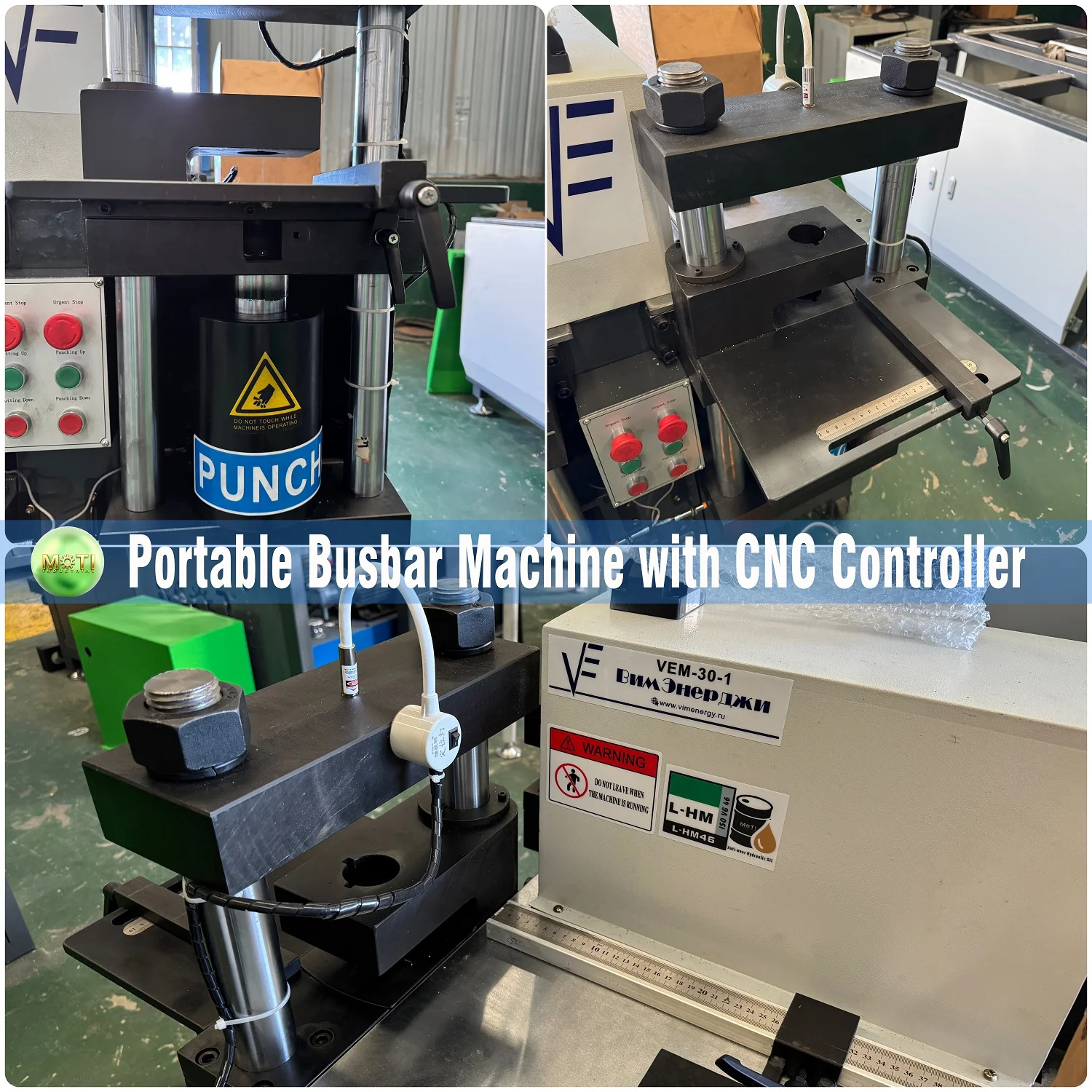
Cutting. A shearing station with an engraved scale rule and a lever-locked sliding back gauge, so a dimension is set once and returned to without a tape measure.
Repeat cuts stay consistent even when the operator changes between shifts.
Punching. Twin-column guided ram, bolted die holders, and a yellow polyurethane pad under the die stack.
The station sits at a working height that suits a standing operator at a bench-height table rather than a machine standing on a factory floor slab.
Bending. A full multi-piece die set covering a range of thicknesses and leg lengths, with the angle data on the MCGS screen.
Because the HMI sits on a folding arm, the operator reads it from a normal working position instead of leaning over the tooling.
Each station has its own panel — Cutting Up / Cutting Down, Punching Up / Punching Down, plus an individual urgent stop
— and its own orange foot pedal, so both hands stay on the workpiece through the stroke.
5. Where the Volume Came From
Shrinking a machine is not a matter of cutting the frame shorter. These are the changes that made the difference:
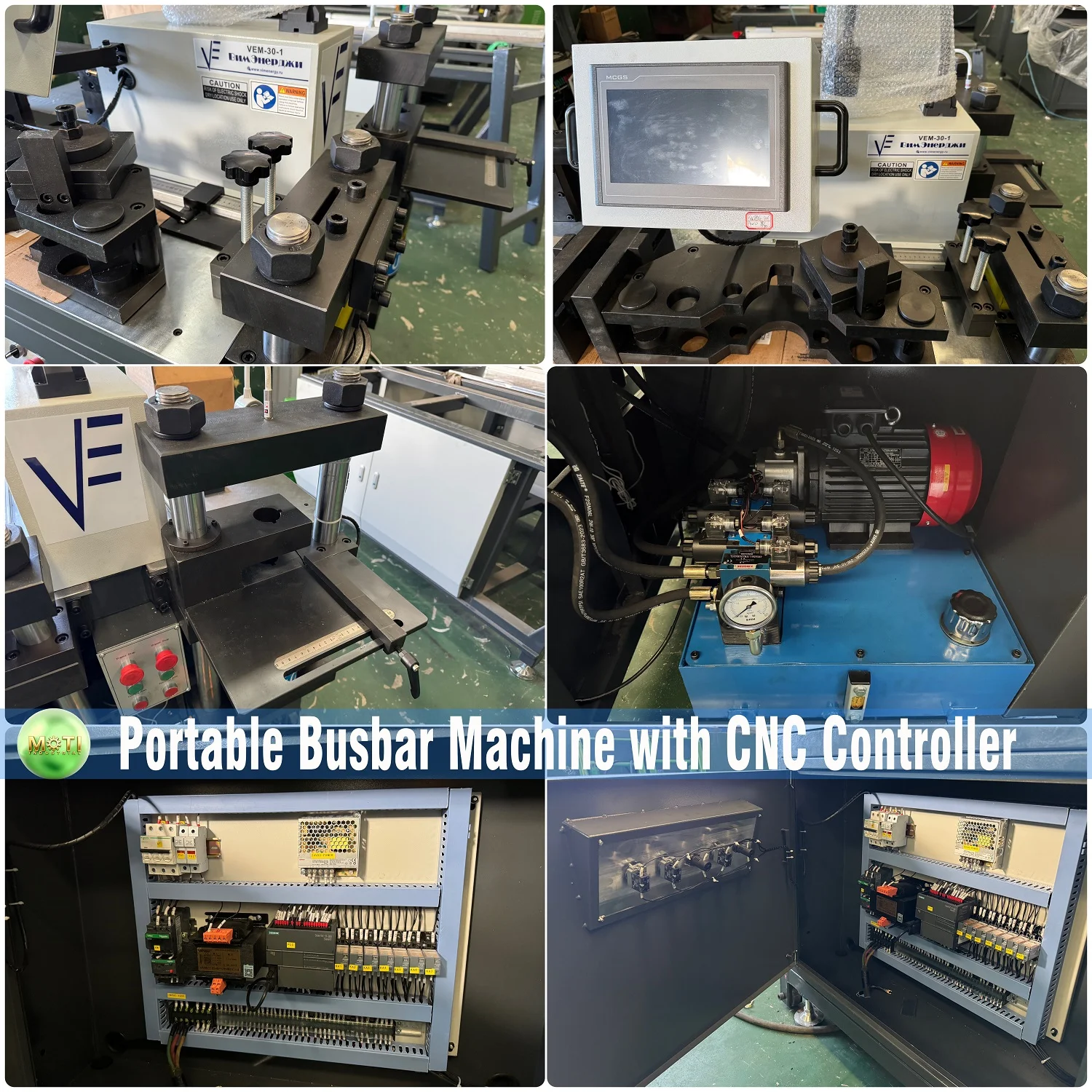
(1) Vertical arrangement of the hydraulic group. The motor, pump, and five-station manifold sit as a compact block inside the base rather than spread along the bed.
Each solenoid valve and coil stays individually replaceable from the front.
(2) A right-sized reservoir. The tank carries a sight-level gauge and a breather/filler cap, dimensioned for the smaller cylinders rather than inherited from a larger machine.
(3) Integrated electrical cabinet. The cabinet is built into the machine base, not added as a separate floor-standing enclosure — one footprint instead of two.
(4) Folding HMI arm. The screen swings in for transport and for tight rooms, and out when the machine is running.
(5) Adjustable leveling feet. The machines are leveled in minutes after being repositioned, which matters when a unit is moved between rooms rather than installed once and forgotten.
(6) Cast base with lifting points. Handling is done with a pallet truck or an engine hoist, not a crane and a rigging crew.
6. A Warm Room Also Means a Cleaner Electrical Environment
Running indoors is not only a comfort decision. It is a better environment for the control system, and this cabinet is built for it.
Inside: a Siemens SIMATIC S7-200 SMART PLC with expansion module, a separate 24 VDC switching power supply, miniature circuit breakers,
and a relay bank labelled KA1 through KA7 protecting the PLC outputs. Wiring runs in slotted trunking, every core carries a printed ferrule number, and the terminal rail is numbered to match the drawing.
The door-mounted relay group sits behind a transparent polycarbonate cover, so a technician can watch a contact pull in without opening a live panel.
A stable indoor temperature keeps that equipment in its design range year-round.
One practical note for any machine moving from a cold truck into a warm room: let it stand and acclimatise before power-up.
Condensation on cold terminals is the single most common cause of a "dead on arrival" control fault, and it has nothing to do with the machine.
7. Safety When the Machine Is Two Metres From a Desk
Small rooms change the safety picture. There is less space between the machine and the people around it, so the hardware has to carry more of the load:
- Main emergency stop on the power panel, plus an individual urgent stop at each working station — reachable from where the operator actually stands;
- Key-switch power control, so the machine cannot be started by anyone without the key;
- Foot-pedal actuation on both units, keeping hands clear of the tooling during the stroke;
- Guarded hydraulic area, covered relay compartment, and warning labels on every pinch point — do not touch while the machine is operating, electric shock risk, dry location use only.
8. Built Under the Customer's Own Brand
These two machines leave our works carrying the customer's nameplate, documentation and panel language, not ours.
The build, the PLC, the hydraulics and the tooling are MOTI's; the brand on the cabinet is our partner's.
Private-label production runs through the same routine as our own-brand machines: assembly check, point-to-point electrical verification, pressure test, stroke and alignment check, then a full cycle run.
A machine built for a distributor has to arrive ready to sell and ready to support — the difference between a partner who reorders and one who has to explain a fault.
9. Packing for a Russian Winter
Cold-weather shipment needs more than a crate. Before loading, machined surfaces are coated with rust preventive, hydraulic oil is checked and topped to the specified grade,
Loose tooling and the die set are packed separately, and the crates are lined with moisture barrier film and desiccant for the sea and rail leg.
Delivery is scheduled for 【 city/region in Russia】. Commissioning support is available remotely, or on site where the customer prefers it —
and because the machines are compact, a single technician can handle installation without a rigging team.
10. A Machine Sized to the Job You Actually Have
Most busbar machine buyers are told to size up: more tonnage, more length, more stations, in case the work grows. That advice assumes the machine has somewhere to live.
If your busbar work happens in a room rather than a hall — a switchgear assembly shop, a panel builder's back office, a maintenance department, a site cabin — the constraint is not capacity.
It is floor space, door width and whether the people doing the work can feel their fingers in January.
Tell us the room you have: its dimensions, its doorway, its power supply and the busbar sizes you run. We will tell you honestly whether a compact configuration fits, and what it will process.
MOTI INDUSTRIAL — busbar machines built around the workshop you actually have.
Contact us for specifications, compact configurations, tooling options and customized solutions.